Much of the research and writing for this page was completed by Piotr Bojanowski of Poznan.
During the late 1980s the state-owned Przemysłowe Celowniki Optyczne (PCO), Industrial Optical Sights sometimes also called the Polskie Celowniki Optyczne or Polish Optical Sights, began work on a new scope and laser aiming device for the military with the intention of producing a cheap yet sturdy optic that could be issued on every service rifle. Early models of what would become the LKA-4 scope were desgined for use on the Tantal rifle in 5.45x39. A small batch of these scopes were delivered to the Polish military where despite great interest the project would not paused due to the collapse of the communist government in Poland.
In January of 1995 at Fabryka Broni Łucznik, the specifications for a new assault rifle chambered for the 5.56x45 SS109 ammunition were formulated. The new rifle and carbine were to be used with optical sights from PCO including: PCS-6 (nightvision), CK-3 (red-dot), LKA-4 (scope), and CWL-1 (scope with laser).
On April 19, 1995, the Department of Development and Implementation of the Ministry of National Defense concluded a contract with Łucznik for the development of technical and design documentation, construction of prototypes (11 rifles and 10 carbines) and conducting of internal factory and qualification tests. On August 13, 1996, the Łucznik plant was commissioned to produce a trial batch of an additional 18 carbines and 6 subcarbines. Following acceptance tests in January 1997, the weapons, along with sights produced by PCO (the number of each model is unknown), were delivered to the Polish military. The rifles and carbines were initially sent to officer training schools in Wrocław, Poznań, and Gdynia for additional testing between June and October 1997. On March 20, 1998, with the signature of the Chief of the General Staff of the Polish Army, the 5.56 mm Model 1996 (Beryl) assault rifle was introduced into the Polish Army. The Radom plant began mass production of the first batch, consisting of 5,000 units, under an agreement signed on July 28, 1999. The rifles were adopted without optical sights, and there was no mention of them in the official military manual.
By this point the PCO had developed two versions of the scope one was the LD-4 (it is unclear when the name changed from LKA-4 to LD-4) which was a simple 3.4x scope. The other was the CWL-1 which incorporated a WL-1 laser sight or a WL-1P infared laser sight. In the case of the CWL-1 the scope and laser were set to converge at a distance of 100m. The laser sight switch is located on the rear and it can be either permanent or momentary (some prototypes used a cable to mount the switch on the trigger). The scope itself did not feature any external controls for adjustment or focus. Instead adjustments were intended to be completed by a dials on the rear of the POPC-I rail the scope mounted to.
Although formally adopted into service, no orders for any of the scopes in the LD-4 family were forthcoming after the tests. Aside from demonstrations at arms fairs and tests in military units, the sight were not used by the military. In the meantime, due to the lack of PCO sights, a new POPC II rail was developed for the weapon, which allowed the mounting of popular sights on a Picatinny rail on Beryls.
Lithuanian special forces ordered 80 Beryl wz.96A rifles (10 with underbarrel grenade launcher PALLAD and 10 with CWL-1 scopes/laser combo). (ALTAIR, 2007)
Specifications for the LD-4 scope are listed as (Polish Ministry of Defense, 2005): Operating range: 600 m
Scope magnification: 3.4x
Viewing angle: 2"20'
Exit pupil diameter: 7 mm
Exit pupil distance: 160 +- 24 mm
Specifications for the WL-1 laser pointer are listed as (Polish Ministry of Defense, 2005): Laser power: 3 mW
Wavelength: 670 nm
Beam divergence - max. 1 mrad
Dimensions: Length - 89 mm
Mounting diameter: 23 mm
Operating range: 100 m;
Power supply: 4x 1.35 V cells
Operating time: 1.5 hours continuous; or 3 hours with breaks.
Images
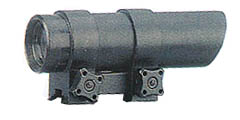
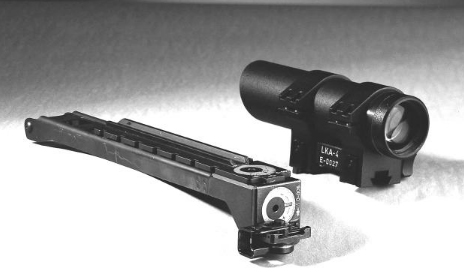
Scope and rail mount. Note scope is marked LKA-4, serial number E-00027. The scope is probably from one of the first batches of scopes produced for testing with the then in developoment Beryl rifle.
The round dials on the rear of the POPC-I rail were used to zero the scope to the rifle.
Mounted on a Mini Beryl. Notice on the right hand side regular hardware nuts are used to tighten the sight to the picitiny rail, unlike the larger black wing nuts seen on other examples.
Oddly the scope is marked CWL-1, but is missing the laser sight which differentiated the CWL-1 from the LD-4.
Again mounted on a Mini Beryl, probably the same example as seen above. When mounted in this fashion to the Mini Beryl their would have been no way to zero the scope to the rifle.
LD-4 mounted on Beryl/Mini Beryl rifles with Polish soldiers.
Lithuanian special forces in Afghanistan 2002/2003. The Beryl has the early POPC-I rail, but it is difficult to tell if the optic is a CWL-1 or not.
Mounted on Beryl/Mini Beryl rifles using the first pattern rail. The addition of the WL-1 (or infrared WL-1P) laser sight would make these CWL-1 sights.
An example of the POPC-1 rail that was used to zero the LD-4 to the rifle.
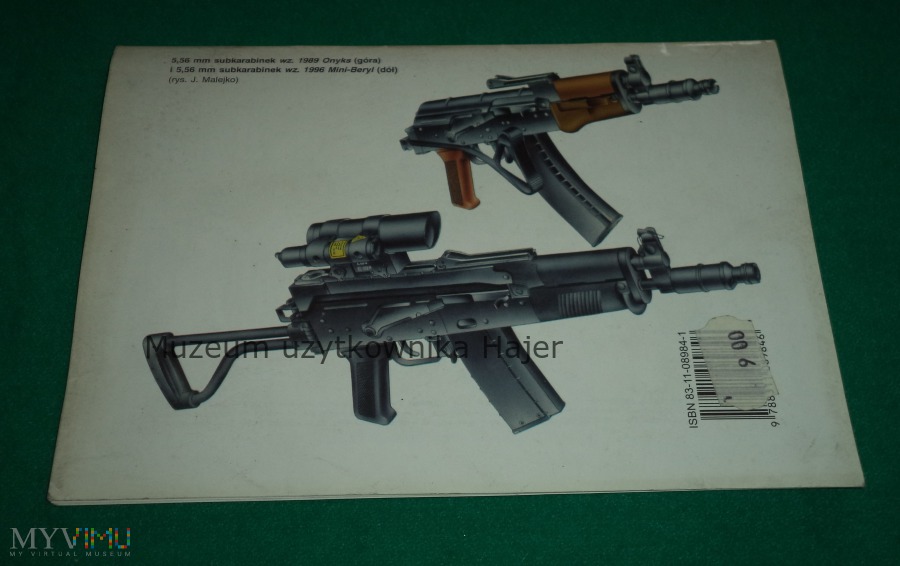
Book rear cover showing an art drawing of a Mini Beryl with CWL-1. ISBN number shows 83-11-08984-1. If anyone knows the book name, or if the book contains additional information on the CWL-1 or other Polish scopes of the late 90s early 2000s, shoot me an email.
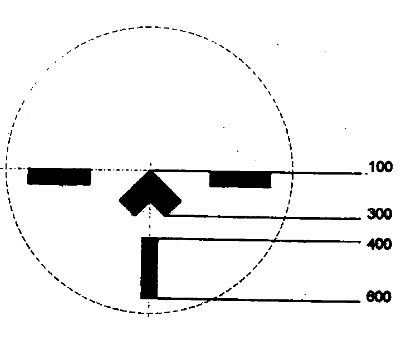
RETICLES
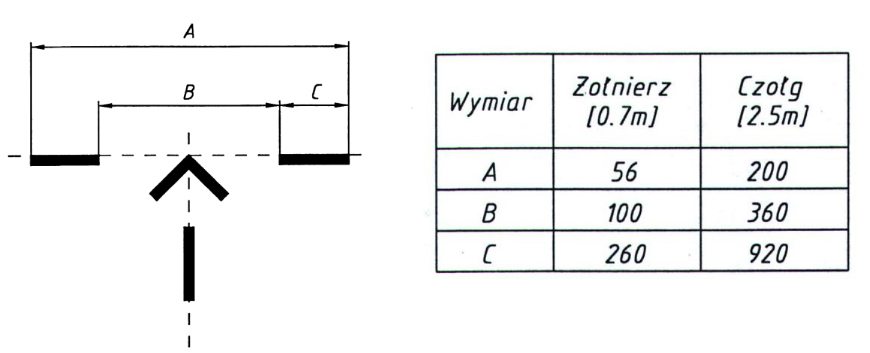
Reticle
with rangefinder table
References
Polish Ministry of Defense (possibly written by Colonel Zdzisław Sakowski). (2005). "OPTYCZNE PRZYRZĄDY CELOWNICZE DO BRONI STRZELECKIEJ (OPTICAL SIGHTS FOR SMALL ARMS). Polish Ministry of Defense.
Aviation Agency ALTAIR Sp. z o.o. (2007). (Retrieved March 21, 2026), english translation G36 dla Litwy. https://www.altair.com.pl/g36-dla-litwy
.jpg)
.jpg)
.jpg)
.jpg)
.jpg)
.jpg)

.jpg)
.jpg)
.jpg)
.jpg)
.jpg)
.jpg)
.jpg)